Showing posts with label competition. Show all posts

Sunday, April 11, 2010

2nd Place! The 2010 State Geography Bee


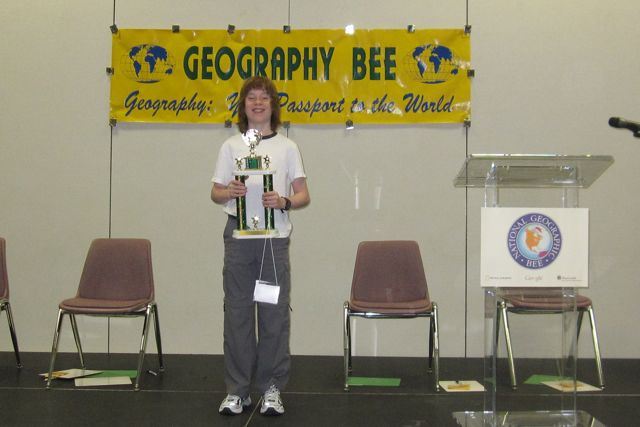
G with his 2nd-place trophy.

We're thrilled that G finally achieved one of his goals with geography and the Geography Bee - reaching the final 10 at the state level - although he would have loved to have won and gone on to compete at Nationals.

We've been asked lots and lots of questions regarding the Geography Bee, hosted by National Geographic, and what it takes to compete. If you'd like to learn more about the Bee, please take a look at G's website GeoBeeUniverse. He plans on spending a lot of time on the site this summer, updating it and compiling more info to help future competitors. For now, you can get at least an idea of what's involved in studying for the Bee. (Keep in mind, however, that we're learning too, and G's site is in no way affiliated with National Geographic.)

Here's how it works, in a nutshell:
(I've listed as examples some of the questions that G received at this year's State Bee, as best I can remember them. As the questions from the Bee are the property of National Geographic and thus copyrighted, if I have accidentally worded the questions here precisely as they have, it is purely coincidental. My memory isn't usually that good. Ha.)

SCHOOL LEVEL:

All interested kids compete. All homeschoolers in a city must compete in the same Bee. (Not sure exactly how schools decide their winner, but the contest for schools and homeschoolers follows the same rules.)

The winner of each school - Austin Area Homeschoolers is considered a school for the purposes of the Bee - takes a written test of 70 multiple-choice questions.

The students with the top 100 scores compete at the State level in Dallas.


G with Eric Yang, the 2009 National Geography Bee winner,
who is from Texas - we got to watch him win State last year.
Believe it or not, Eric is less than a year older than G;
he plays basketball. Can you tell?


STATE LEVEL (Nationals follows the same procedure as State):

Preliminary Round: This round is held to determine which 10 competitors will compete in the Final Round.

The 100 competitors (sometimes a few more, if there was a tie for the top scores) are broken into 5 groups. Each group is asked the same series of questions, consisting of 8 rounds. That is, each competitor must answer 8 questions, 1 in each round. Each round is in a different category, such as bodies of water, famous landmarks, or country borders. The questions might be U.S. questions or world questions within each round.

In past years in Texas, there have been more than 10 competitors with perfect scores in the Preliminary Round. In 2009, there were 17 perfect scores, and in 2008, there were 19. Those competitors answered as many tiebreakers as necessary to whittle the number down to 10.

However, this year only 6 received perfect scores in Preliminaries - one of which was G. That allowed him the luxury of resting during the tiebreaker round.

Final Round: This round is held to narrow the field to 2 competitors, who will compete in the Championship Round.

The Final Round is double elimination, meaning that competitors are allowed one miss and are eliminated after the second miss.

First Round: U.S. Geography
Example question: Natchez Trace Parkway, which runs through Mississippi and Alabama, ends in which state located to the north? (Tennessee)

Second Round: Google Imagery (Google is a sponsor of the Bee)
Example question: West Thumb Geyser Basin is located on the edge of Yellowstone Lake in which state? (Wyoming)

Third Round: All competitors answered this question on individual white boards
Example question: Canada's Waterton Lakes National Park, located in Alberta, forms an International Peace Park with a U.S. National Park located in what state to the south? (Montana)

Fourth Round: This was a bar graph on U.S. Foreign Assistance. The competitors had to look at the graph and answer questions. I don't have an example for this round, since you'd have to see the graph for it to make sense.

Fifth Round: Analogies
Example question: Green Bay is to Lake Michigan as Saginaw Bay is to what? (Lake Huron)

Sixth Round: Country Borders
Example question: What country borders Burkina Faso and Libya? (Niger)

Seventh Round: Again, all competitors answered this question on individual white boards
The Baikal-Amur Mainline, with close to 2,000 miles of track, takes its name from a lake and river in the eastern part of which country? (Russia)

Eighth+ Round: At this point, there are no more categories. The moderator simply goes down a list of questions and continues until a competitor has two misses, at which time he is eliminated. (BTW, there were no girls in this year's Final Round.)
There were still 7 competitors in the game at this point, but they dropped off one by one.
Example question: Efforts have been made to clean up the estuary of the Thames River, located in the southeastern part of what country? (United Kingdom)
Example question: In the 1940s, mining of bauxite shifted this island country's main export from bananas and sugar. Name this country. (Jamaica)
Example question: In the 1960s, Rwanda and Burundi gained independence from what European country? (Belgium) The audience audibly exhaled at G's correct answer, and the moderator shook his head, chuckled, and said, "Amazing."
Example question: Fogo, Sao Tiago, and Boa Vista are part of which Atlantic island group? (Cape Verde Islands)
Example question: What island east of St. Vincent gained its independence in 1966? (Barbados)
Third-place competitor goes out. G and one other competitor are the only two left - they had both missed one question at this point, G missing the last question asked in the Final Round, one about an ancient carved Buddha statue located in a country, with no geographic clues given.

Championship Round: When the field is down to two contestants, the slate is wiped clean and 3 championship questions are asked. The winner is the competitor who answers the most questions correctly. However, both competitors answered all three questions correctly.
Example question: Jedda, the port for the holy city of Mecca, is located on what body of water? (Red Sea)

Since all three questions were answered correctly, tiebreakers were asked in sudden death. Both of the first two tiebreakers were answered correctly.
Example question: What country includes the islands of Melville, Mornington, and Bathurst? (Australia) Note: Although our competitors answered this question correctly, there must have been some controversy surrounding it, because two of the islands are also found in Canada, and National Geographic doesn't ask "trick" questions. Apparently, Mornington was changed to Wellesley in the state bees in later time zones.

The question that decided the Bee - which was painful to G for the simple fact that he had studied this but couldn't pull up the answer in time - was this:
The island of Rapa Nui is more commonly known by what English name? (Easter Island)

All in all, an exciting and victorious day. G still has something to strive for next year, so not at all a bad thing.

Wednesday, September 30, 2009

The Check's in the Mail


Some of our geography books.

It really is. In the mail, that is. The check. Along with our registration for the 2010 National Geographic Bee. Sent certified.

The folks at NatGeo are amazing. About 6,000,000 children compete in the Bee every year, from thousands of schools and homeschooling groups. The efforts to organize this thing must be phenomenal. I can't even imagine.

And do you know what those good folks did? They called me to make sure we were registering this year.


G studying with maps that H made.

Let me back up a bit. Austin Area Homeschoolers (actually yours truly, for the benefit of yours truly's oldest kid) has been the organizer for the Bee for homeschoolers in Austin for the last three years. NatGeo allows only one homeschooling Bee per city or town, probably to keep homeschoolers from having a bunch of small Bees in each city. So in Austin, we're it - at least we have been for the last three years.

This year, I needed to talk to someone at NatGeo before sending in our registration, and I hadn't gotten around to it yet. (I know ... shocker.) You can imagine my surprise when I picked up the phone and heard, "Hello, this is Erin from the National Geographic Bee."

It turns out that another homeschooling group in Austin had sent in their registration. I would have figured that it would be "First come, first served." I certainly wouldn't have expected that they would take the time to call.

I know it's not like one of them said, "Hey, here's a registration from a group in Austin that's not Austin Area Homeschoolers. Hmm. Maybe I should call Camille and see what's up." It's just that I think it's nice to have the personal touch occasionally, especially from such a huge organization. And it's awfully nice that they gave us the option of hosting, especially since they could have said, "You snooze, you lose."

Guess their mama raised them right.

G at last year's state bee.

So we're it once again. This year G wants to go all the way to Washington. Indeed, he wants to make Texas the first state to win the National Bee two years in a row. He has a tough road ahead of him, but I know he can do it if he continues to study the way he has been and has a smidgen of luck.
___________________
If you liked this post, you might enjoy Geography Games and you might want to check out G's GeoBee study site, GeoBee Universe.

Sunday, May 31, 2009

Sunday's Gratitude Post

I never thought I'd say this, but today I'm grateful for soccer. Yes, soccer. 

This weekend was G's last-ever soccer weekend: the state championship. He has decided that, after 6 years of playing, he's done. And what a way to go out.

Their team won the championship! Undefeated! State champions!

What makes it even more meaningful is that this is the first time G's team has ever won first in any tournament. They always did well, but the best they ever got was second. So it makes it an even more precious win.


Notice the lone blue ribbon.

What's more - and this is why I'm so grateful - is that in their last game today G was paired against the best player on the opposing team. G is not our team's best player, and in past seasons he's lost much of his confidence due to back-to-back injuries, but today he rose to the challenge. He got paired with that player simply because their positions coincided. And G consistently shut him down, playing harder than he has all year.

So today I'm grateful ... for successes hard won, agonizing decisions finalized, confidences rebuilt, a team bonded and then dispersed, and the knowledge of one 12-year-old boy that he made a difference in something bigger than himself.

Thursday, May 7, 2009

Tutoring for Success?

Emma sits at a desk and stares at the work in front of her. Across the table sits her tutor, with whom Emma meets twice a week after school. Emma's parents are concerned that, without tutoring, she won't be ready for the next school year. They see a line of dominos falling, with Emma ultimately not being able to get a into a prestigious college and have a successful career.

Her parents have heard great things about this tutoring facility ... that in just six months they can improve a student's abilities a full year's worth. That, they believe, will give Emma just the boost she needs to succeed. After all, she'll have lots of competition in the exclusive private school that her parents have given a hefty check to in the hopes that she'll be accepted.

Emma stares blankly, twirling her dark hair, clearly not interested in the work put before her. She doesn't see the point of all this. College and career? They're way too distant in the future. She doesn't understand what all the fuss is about. 

Emma's mind wanders and she picks her nose. She'd rather be riding her tricycle.

You see, Emma is 3. 

She's in one of the fastest-growing demographics for tutoring. Her parents have bought into the hype that their kids have to be smarter, start earlier, and know more than everyone else in order to succeed. How sad for those kids ... those preschoolers.

Research has shown time and time again that play-based learning at an early age is all that kids need. Indeed, cramming reading and math down the throats of toddlers can cause a host of problems: stress, decreased creativity, lower self-esteem, and a thin wallet. (Some tutoring sessions can be as high as $45 per half hour.) Recent brain-imaging data have revealed that most children's brains aren't developmentally ready to read until around age 5. So why the rush?

And speaking of rushing our kids, what's the deal with kindergarten? What happened to kindergarten as a time for play, with sandboxes, songs, and corny dances? Too often our kindergarteners are taking assessments and doing homework. When I was 5 (and yes, I'm all too aware of just how long ago that was - my kids seriously asked me if television had been invented when I was their age), we played outside and banged around on percussion instruments. Heck, most of us didn't even attend kindergarten - we dug in the dirt and ran around outside and went with our mothers to the grocery store and took naps (something I think should be instituted for all adults over 45).

If early reading and math proficiency is supposed to pave the way to success for our children, and if more and more parents are forcing this down the throats of their babies, why oh why isn't the United States at the top of the list educationally compared to other countries? Year after year, the United States lags behind other developed countries in math and science. But if our early-push efforts and our stress on early learning aren't paying off in the long term, why do we subject our children to this?

It doesn't stop at kindergarten. When my oldest was in 2nd grade, many of his peers were in the accelerated math class at the local elementary school. The idea was that in 2nd grade, the information in 2nd and 3rd would be "compacted" so that they kids would be ahead one full year in math, thus finishing algebra before high school so that they could finish calculus before graduation. I talked with some moms during this year (2nd grade), and they were all so proud that their kids had tested into the program. (They tested at the end of the 1st grade.)

I was curious about the flip side ... what did the kids think about it? Well, the moms said, they had tons of homework that they weren't always crazy about. And of course, with all the extracurricular things that kids do today (soccer, ballet, etc.), they had to drop something. You want to know what each and every one of the kids had to drop to take the compacted math? Playdates. Yup, at age 7, kids were having to focus on math so much that they had to cut back on - or cut out - their play time.

I see so much wrong with this approach. I know, I know ... the intent is honest and even honorable. They want their kids to achieve, to remain interested, to learn along with like-minded peers, and to have every opportunity. But they're sacrificing their children's childhood in the process.

Are administrators wising up to the fact that this could be hurting instead of helping our kids? Maybe. I was heartened to find this article when I went to do a little research on compacted math. It turns out that our school district has rethought this practice and will be changing it for the 2010-11 school year. They'll be testing kids in 6th grade, when new material comprises only 30% of the math curriculum, instead of 1st, when it's 60%. As they say in the article, it also catches kids that might have been missed in 1st grade and gives them advanced material when they're developmentally ready. One elementary teacher said that "the sense of failure resulting from the situation can turn capable students off math and away from advanced learning" (quoted from the article that quotes her).

But what's the biggest benefit to not pushing our kids? That little nugget is missing in the article. It's this: the kids get to be kids again.

"But wait!" you shout with alarm. (I can hear you from here.) "My kid is ahead of the curve and bored in class!" The school district plans to handle that with Gifted classes, they say. (Personally, I'm a bit skeptical.)

Unfortunately, there's no one solution that meets everyone's needs. By the very nature of classrooms, there will always be some kids struggling to keep up and others bored waiting for the rest to catch up. People have been trying for ages to figure out how to make our current schooling strategy work for every child, and there's simply no way. (Besides, my opinions of what's wrong and right with our schools is far too long for this post.)

But one thing is clear. Pushing kids academically before they're ready is no solution. Taking away their play time is no way to make them happy learners. The years of imagination are so short; let's not hurry them into adulthood.

And what about Emma? Is she doomed to a life of worksheets and tutors instead of dolls and bugs? Fortunately, she and her parents exist only in my mind and are simply composites of people I found described in internet articles. But there are plenty of real-life versions just like her. Sigh.

Sunday, April 19, 2009

Competition: From the Kids' Views

I have one child who's competitive and goal driven and two who focus on the doing rather than the getting there. Do I even need to say how much friction occurs when all three try to play a game?

I'm reminded of a vivid memory of my childhood. My family often played games together, but one of the games that we rarely played was Monopoly. We all thought it was a great game and enjoyed it when any particular game was long and involved. So why didn't we play very often? The simple reason is that my middle sister and I liked to play for the enjoyment of being together, and my mom and my older sister played to win (I almost wrote that they were cutthroat, but that would be judgmental, wouldn't it? hehe). My oldest sis would revel in bankrupting someone and booting them out of the game on her way to victory, while I would cry and beg her to show mercy. And I would make her crazy when I would lend money to my middle sis under the table so that we could all keep playing, while my mom would cry foul and demand that she pay up out of her own account, bankruptcy or no.

At the time, I could never understand how they could be so heartless, and they could never understand how we could be so
spineless. I see now that it was more a matter of who we were and what made us tick. To this day, my oldest sister has pictures on her walls of goals she's striving to reach, and she'll drive all night to reach a destination. And my middle sis has ongoing projects lying around to be tackled when the mood strikes, and she'll plan trips with side-stops along the way.

So which one of us was "right"? Obviously I was! Not really, of course. Either type of personality has its strong points, and - like in many things - most of us fall somewhere between the extremes. 

From G's perspective, competition "makes things interesting." Without the geography bee to work toward, he never would have learned the information he's learned and to the depth that he knows it - by his own admission. To him, a competition adds spice and intrigue. It's a challenge, a dare, a test of skills. It's adrenaline, fast-pumping action, and thinking fast on your feet.

S, however, much prefers contests to competitions. She enjoys spending time on a project with an eye to entering it into a contest, rather than a head-to-head competition. She'd rather take time and effort to create something with thought, whether it will be judged against others' work or just enjoyed by herself. To her, competition can be intimidating, nerve wracking, and stressful. 

Most of us don't want our kids to be subjected to the intense competitive environment prevalent in some other countries. The suicide rate in Japan - with its reputation as the "suicide capital of the world" - is way high, over 30,000 in 2007, as is random stabbings. Some say this is because of the highly competitive society (although clearly reasons behind suicide are multifaceted).

But we also don't want our kids to have no drive and no direction. 

I'm of the generation when trophies meant something. If you had a shelf full of trophies, you had actually earned them (I didn't have a one). While I secretly envied my friends with trophies, I also knew I didn't have the desire to go out and win one. 

These days any kid whose parents paid for a camp, a class, or membership to a team wins (gets) a trophy. And because just about every kid has a shelf full of trophies these days, the trophies that are actually awards are HUGE! I mean, good grief, G has over forty - FORTY - trophies or medals, and only a few of them were actual awards. That doesn't mean that he's some remarkable prodigy by any stretch of the imagination. What it actually means is that we ponied up the money to have him take a camp or participate in a tournament.

What's that saying, "When everybody's a winner, nobody's a winner"? Something like that?

It might seem like I'm making a strong case for competition. I'm not. What I'm saying instead is that competition has its place, and teamwork has its place, and there's a place for every person to shine. It doesn't have to be competition, but sometimes that's the best option.

Every person, every child has a gift and a talent. But competition is something that, like everything else in a child's life, must be decided in the best interest of the child. 

Wednesday, April 15, 2009

Competition: The Hope for the Future or the Scourge of a Generation?

Is competition good or bad?

Ask the coach of a Big 12 football team or an older-generation professor from a high-powered university, and you'd probably get a resounding "Good, obviously!" or maybe even "Essential!"

Ask a Waldorf parent or a Montessori teacher, and the answer might be "Definitely bad." or even "Detrimental to mental health."

Obviously, it depends on who you ask, but it also depends--most importantly--on the kid. As in many things, what's perfect for one kid may be disastrous for another.

One kid might need an external goal to achieve anything worthwhile and may thrive on the excitement of head-to-head mental combat. That kid may need the thrill of the game, the impending deadline, the worthy opponent. That person may say there's no point learning anything unless there's a challenge at the end of the road. After all, that path that meanders through the woods in a loop, simply there to let you view the sights and put you back where you started, holds no interest. What's the point of that? To that kid, the destination is the prize, not the journey.

Another kid sees life as a process, not a series of goals. This child seeks out those meandering trails, wandering with wonder along the loop, pleased to see the sights before arriving back to the safety and comfort of home. Along the way, this child finds knowledge because it's there to be taken, not because of a challenge. If this kid knew that at the end of the trail lay a worthy opponent, ready to duke it out mentally, he would never set foot on the path. He would be intimidated, or he would be confused as to the purpose of the competition, or he might just hate to lose. For this kid, the journey is the prize, not the destination.

What are the dangers if you force the goal-oriented kid into a learning environment that focuses on "everybody is equal"?  Well, the most obvious, of course, is boredom. Apathy. Loss of the love of learning. If everyone gets a trophy at the end, what's the point of doing my best? If my efforts aren't recognized, why try? What's the goal? Here's a big one: loss of a sense of identity. How can I show the world who I am, if I'm seen to be just like everyone else?

What are the pitfalls if you force the process kid into a learning environment that focuses on competition? Clearly, a loss of self-confidence if the child is forced into a competition and fails. More than one child has given up something he loves because he lost in a test of ability, even if that test didn't accurately measure that ability. At the extreme, a child can refuse to learn. ("What's the point? I'll lose.") For a certain personality, competition--especially in a non-nurturing environment--can crush a child's spirit. What if the child has gifts in some area (say, a creative area, like art or music) but is forced to compete in purely academic competitions? The results can be far-reaching, as in killing even the creativity and thus the gifts.

So what's the answer? To compete or not to compete? Once again, it all comes down to knowing our kids--knowing their personalities, their strengths, their weaknesses, those areas that need to be developed, those areas that are strong and need to be expressed--and respecting them as people, and finding the right fit for them. It's a monumental task. 

And what if you have kids with different personalities? How do you teach the goal-oriented kid that "winning isn't everything" and how do you show the process kid that "victory is sweet"? Should you?

That's a topic for tomorrow. Check back, and I'll tell you all about what my kids--both competitive and non-competitive--have to say about competition.