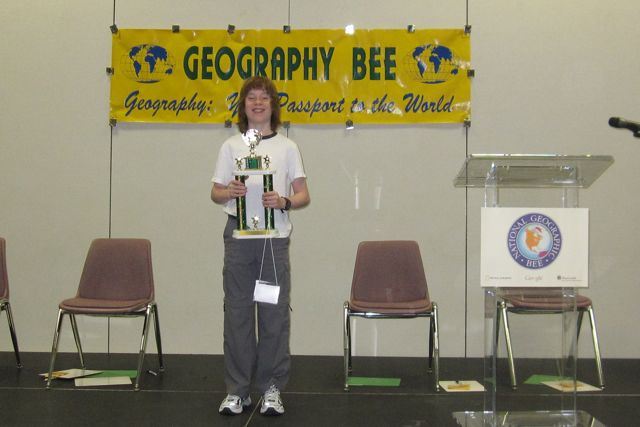
G with his 2nd-place trophy.
We're thrilled that G finally achieved one of his goals with geography and the Geography Bee - reaching the final 10 at the state level - although he would have loved to have won and gone on to compete at Nationals.
We've been asked lots and lots of questions regarding the Geography Bee, hosted by National Geographic, and what it takes to compete. If you'd like to learn more about the Bee, please take a look at G's website GeoBeeUniverse. He plans on spending a lot of time on the site this summer, updating it and compiling more info to help future competitors. For now, you can get at least an idea of what's involved in studying for the Bee. (Keep in mind, however, that we're learning too, and G's site is in no way affiliated with National Geographic.)
Here's how it works, in a nutshell:
(I've listed as examples some of the questions that G received at this year's State Bee, as best I can remember them. As the questions from the Bee are the property of National Geographic and thus copyrighted, if I have accidentally worded the questions here precisely as they have, it is purely coincidental. My memory isn't usually that good. Ha.)
SCHOOL LEVEL:
All interested kids compete. All homeschoolers in a city must compete in the same Bee. (Not sure exactly how schools decide their winner, but the contest for schools and homeschoolers follows the same rules.)
The winner of each school - Austin Area Homeschoolers is considered a school for the purposes of the Bee - takes a written test of 70 multiple-choice questions.
The students with the top 100 scores compete at the State level in Dallas.

G with Eric Yang, the 2009 National Geography Bee winner,
who is from Texas - we got to watch him win State last year.
Believe it or not, Eric is less than a year older than G;
he plays basketball. Can you tell?
STATE LEVEL (Nationals follows the same procedure as State):
Preliminary Round: This round is held to determine which 10 competitors will compete in the Final Round.
The 100 competitors (sometimes a few more, if there was a tie for the top scores) are broken into 5 groups. Each group is asked the same series of questions, consisting of 8 rounds. That is, each competitor must answer 8 questions, 1 in each round. Each round is in a different category, such as bodies of water, famous landmarks, or country borders. The questions might be U.S. questions or world questions within each round.
In past years in Texas, there have been more than 10 competitors with perfect scores in the Preliminary Round. In 2009, there were 17 perfect scores, and in 2008, there were 19. Those competitors answered as many tiebreakers as necessary to whittle the number down to 10.
However, this year only 6 received perfect scores in Preliminaries - one of which was G. That allowed him the luxury of resting during the tiebreaker round.
Final Round: This round is held to narrow the field to 2 competitors, who will compete in the Championship Round.
The Final Round is double elimination, meaning that competitors are allowed one miss and are eliminated after the second miss.
First Round: U.S. Geography
Example question: Natchez Trace Parkway, which runs through Mississippi and Alabama, ends in which state located to the north? (Tennessee)
Second Round: Google Imagery (Google is a sponsor of the Bee)
Example question: West Thumb Geyser Basin is located on the edge of Yellowstone Lake in which state? (Wyoming)
Third Round: All competitors answered this question on individual white boards
Example question: Canada's Waterton Lakes National Park, located in Alberta, forms an International Peace Park with a U.S. National Park located in what state to the south? (Montana)
Fourth Round: This was a bar graph on U.S. Foreign Assistance. The competitors had to look at the graph and answer questions. I don't have an example for this round, since you'd have to see the graph for it to make sense.
Fifth Round: Analogies
Example question: Green Bay is to Lake Michigan as Saginaw Bay is to what? (Lake Huron)
Sixth Round: Country Borders
Example question: What country borders Burkina Faso and Libya? (Niger)
Seventh Round: Again, all competitors answered this question on individual white boards
The Baikal-Amur Mainline, with close to 2,000 miles of track, takes its name from a lake and river in the eastern part of which country? (Russia)
Eighth+ Round: At this point, there are no more categories. The moderator simply goes down a list of questions and continues until a competitor has two misses, at which time he is eliminated. (BTW, there were no girls in this year's Final Round.)
There were still 7 competitors in the game at this point, but they dropped off one by one.
Example question: Efforts have been made to clean up the estuary of the Thames River, located in the southeastern part of what country? (United Kingdom)
Example question: In the 1940s, mining of bauxite shifted this island country's main export from bananas and sugar. Name this country. (Jamaica)
Example question: In the 1960s, Rwanda and Burundi gained independence from what European country? (Belgium) The audience audibly exhaled at G's correct answer, and the moderator shook his head, chuckled, and said, "Amazing."
Example question: Fogo, Sao Tiago, and Boa Vista are part of which Atlantic island group? (Cape Verde Islands)
Example question: What island east of St. Vincent gained its independence in 1966? (Barbados)
Third-place competitor goes out. G and one other competitor are the only two left - they had both missed one question at this point, G missing the last question asked in the Final Round, one about an ancient carved Buddha statue located in a country, with no geographic clues given.
Championship Round: When the field is down to two contestants, the slate is wiped clean and 3 championship questions are asked. The winner is the competitor who answers the most questions correctly. However, both competitors answered all three questions correctly.
Example question: Jedda, the port for the holy city of Mecca, is located on what body of water? (Red Sea)
Since all three questions were answered correctly, tiebreakers were asked in sudden death. Both of the first two tiebreakers were answered correctly.
Example question: What country includes the islands of Melville, Mornington, and Bathurst? (Australia) Note: Although our competitors answered this question correctly, there must have been some controversy surrounding it, because two of the islands are also found in Canada, and National Geographic doesn't ask "trick" questions. Apparently, Mornington was changed to Wellesley in the state bees in later time zones.
The question that decided the Bee - which was painful to G for the simple fact that he had studied this but couldn't pull up the answer in time - was this:
The island of Rapa Nui is more commonly known by what English name? (Easter Island)
All in all, an exciting and victorious day. G still has something to strive for next year, so not at all a bad thing.


 Posts
Posts


