Showing posts with label geography. Show all posts

Sunday, April 11, 2010

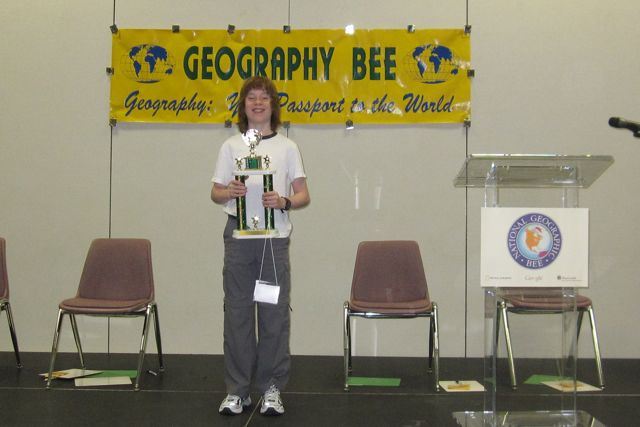
2nd Place! The 2010 State Geography Bee


G with his 2nd-place trophy.

We're thrilled that G finally achieved one of his goals with geography and the Geography Bee - reaching the final 10 at the state level - although he would have loved to have won and gone on to compete at Nationals.

We've been asked lots and lots of questions regarding the Geography Bee, hosted by National Geographic, and what it takes to compete. If you'd like to learn more about the Bee, please take a look at G's website GeoBeeUniverse. He plans on spending a lot of time on the site this summer, updating it and compiling more info to help future competitors. For now, you can get at least an idea of what's involved in studying for the Bee. (Keep in mind, however, that we're learning too, and G's site is in no way affiliated with National Geographic.)

Here's how it works, in a nutshell:
(I've listed as examples some of the questions that G received at this year's State Bee, as best I can remember them. As the questions from the Bee are the property of National Geographic and thus copyrighted, if I have accidentally worded the questions here precisely as they have, it is purely coincidental. My memory isn't usually that good. Ha.)

SCHOOL LEVEL:

All interested kids compete. All homeschoolers in a city must compete in the same Bee. (Not sure exactly how schools decide their winner, but the contest for schools and homeschoolers follows the same rules.)

The winner of each school - Austin Area Homeschoolers is considered a school for the purposes of the Bee - takes a written test of 70 multiple-choice questions.

The students with the top 100 scores compete at the State level in Dallas.


G with Eric Yang, the 2009 National Geography Bee winner,
who is from Texas - we got to watch him win State last year.
Believe it or not, Eric is less than a year older than G;
he plays basketball. Can you tell?


STATE LEVEL (Nationals follows the same procedure as State):

Preliminary Round: This round is held to determine which 10 competitors will compete in the Final Round.

The 100 competitors (sometimes a few more, if there was a tie for the top scores) are broken into 5 groups. Each group is asked the same series of questions, consisting of 8 rounds. That is, each competitor must answer 8 questions, 1 in each round. Each round is in a different category, such as bodies of water, famous landmarks, or country borders. The questions might be U.S. questions or world questions within each round.

In past years in Texas, there have been more than 10 competitors with perfect scores in the Preliminary Round. In 2009, there were 17 perfect scores, and in 2008, there were 19. Those competitors answered as many tiebreakers as necessary to whittle the number down to 10.

However, this year only 6 received perfect scores in Preliminaries - one of which was G. That allowed him the luxury of resting during the tiebreaker round.

Final Round: This round is held to narrow the field to 2 competitors, who will compete in the Championship Round.

The Final Round is double elimination, meaning that competitors are allowed one miss and are eliminated after the second miss.

First Round: U.S. Geography
Example question: Natchez Trace Parkway, which runs through Mississippi and Alabama, ends in which state located to the north? (Tennessee)

Second Round: Google Imagery (Google is a sponsor of the Bee)
Example question: West Thumb Geyser Basin is located on the edge of Yellowstone Lake in which state? (Wyoming)

Third Round: All competitors answered this question on individual white boards
Example question: Canada's Waterton Lakes National Park, located in Alberta, forms an International Peace Park with a U.S. National Park located in what state to the south? (Montana)

Fourth Round: This was a bar graph on U.S. Foreign Assistance. The competitors had to look at the graph and answer questions. I don't have an example for this round, since you'd have to see the graph for it to make sense.

Fifth Round: Analogies
Example question: Green Bay is to Lake Michigan as Saginaw Bay is to what? (Lake Huron)

Sixth Round: Country Borders
Example question: What country borders Burkina Faso and Libya? (Niger)

Seventh Round: Again, all competitors answered this question on individual white boards
The Baikal-Amur Mainline, with close to 2,000 miles of track, takes its name from a lake and river in the eastern part of which country? (Russia)

Eighth+ Round: At this point, there are no more categories. The moderator simply goes down a list of questions and continues until a competitor has two misses, at which time he is eliminated. (BTW, there were no girls in this year's Final Round.)
There were still 7 competitors in the game at this point, but they dropped off one by one.
Example question: Efforts have been made to clean up the estuary of the Thames River, located in the southeastern part of what country? (United Kingdom)
Example question: In the 1940s, mining of bauxite shifted this island country's main export from bananas and sugar. Name this country. (Jamaica)
Example question: In the 1960s, Rwanda and Burundi gained independence from what European country? (Belgium) The audience audibly exhaled at G's correct answer, and the moderator shook his head, chuckled, and said, "Amazing."
Example question: Fogo, Sao Tiago, and Boa Vista are part of which Atlantic island group? (Cape Verde Islands)
Example question: What island east of St. Vincent gained its independence in 1966? (Barbados)
Third-place competitor goes out. G and one other competitor are the only two left - they had both missed one question at this point, G missing the last question asked in the Final Round, one about an ancient carved Buddha statue located in a country, with no geographic clues given.

Championship Round: When the field is down to two contestants, the slate is wiped clean and 3 championship questions are asked. The winner is the competitor who answers the most questions correctly. However, both competitors answered all three questions correctly.
Example question: Jedda, the port for the holy city of Mecca, is located on what body of water? (Red Sea)

Since all three questions were answered correctly, tiebreakers were asked in sudden death. Both of the first two tiebreakers were answered correctly.
Example question: What country includes the islands of Melville, Mornington, and Bathurst? (Australia) Note: Although our competitors answered this question correctly, there must have been some controversy surrounding it, because two of the islands are also found in Canada, and National Geographic doesn't ask "trick" questions. Apparently, Mornington was changed to Wellesley in the state bees in later time zones.

The question that decided the Bee - which was painful to G for the simple fact that he had studied this but couldn't pull up the answer in time - was this:
The island of Rapa Nui is more commonly known by what English name? (Easter Island)

All in all, an exciting and victorious day. G still has something to strive for next year, so not at all a bad thing.

Wednesday, September 30, 2009

The Check's in the Mail


Some of our geography books.

It really is. In the mail, that is. The check. Along with our registration for the 2010 National Geographic Bee. Sent certified.

The folks at NatGeo are amazing. About 6,000,000 children compete in the Bee every year, from thousands of schools and homeschooling groups. The efforts to organize this thing must be phenomenal. I can't even imagine.

And do you know what those good folks did? They called me to make sure we were registering this year.


G studying with maps that H made.

Let me back up a bit. Austin Area Homeschoolers (actually yours truly, for the benefit of yours truly's oldest kid) has been the organizer for the Bee for homeschoolers in Austin for the last three years. NatGeo allows only one homeschooling Bee per city or town, probably to keep homeschoolers from having a bunch of small Bees in each city. So in Austin, we're it - at least we have been for the last three years.

This year, I needed to talk to someone at NatGeo before sending in our registration, and I hadn't gotten around to it yet. (I know ... shocker.) You can imagine my surprise when I picked up the phone and heard, "Hello, this is Erin from the National Geographic Bee."

It turns out that another homeschooling group in Austin had sent in their registration. I would have figured that it would be "First come, first served." I certainly wouldn't have expected that they would take the time to call.

I know it's not like one of them said, "Hey, here's a registration from a group in Austin that's not Austin Area Homeschoolers. Hmm. Maybe I should call Camille and see what's up." It's just that I think it's nice to have the personal touch occasionally, especially from such a huge organization. And it's awfully nice that they gave us the option of hosting, especially since they could have said, "You snooze, you lose."

Guess their mama raised them right.

G at last year's state bee.

So we're it once again. This year G wants to go all the way to Washington. Indeed, he wants to make Texas the first state to win the National Bee two years in a row. He has a tough road ahead of him, but I know he can do it if he continues to study the way he has been and has a smidgen of luck.
___________________
If you liked this post, you might enjoy Geography Games and you might want to check out G's GeoBee study site, GeoBee Universe.

Thursday, September 24, 2009

Geography Games

I frequently have people ask me how G studies for geography, and I never have a good answer. He uses tons of different resources - atlases, encyclopedias, online sources, books, audiobooks, videos, map work with Dad, and other resources - so there are far too many to list. (If you're really interested, you can look at our geography bee website, GeoBeeUniverse, to see an incomplete listing under "Resources.")

When they ask, I usually hem and haw and finally just shrug and smile. But one thing I tell them that we did a lot of early on was play games.

We have a number of online geography games listed on our "Fun Stuff" page on GeoBeeUniverse (one of G's favorites is Traveler IQ Challenge), but these are by no means all. There are tons of great options online; it just takes some digging to find the best.

I'll list a few of our favorite board games here.


Take Off! was a perennial favorite. We came back to this game again and again. The map (playing board) was beautiful and durable, and the kids loved the tiny little fleets of jets. One thing we all liked about it was that we could play cooperatively.

The Borderline games were some of our favorites.


Unfortunately, they seem to be discontinued in some places, but Rainbow Resource had Borderline World and Borderline Europe. We have USA and World and played them many, many times. One of the great things about this game(s) is that it's only a bit bigger than the size of a deck of cards, so it's portable. Perfect for tucking in your bag to pull out while waiting in line with cranky kids.


This game we played some, but it wasn't one we came back to as often as Borderline.


A couple of geography games that we have heard are fun but don't own:


______________
If you enjoyed this post, you might like Cooperative Games.


Tuesday, August 18, 2009

Gearing up for "School"


Today's attempt at hands-on learning.
A sort-of shinai and a bamboo, duct-taped, "sword"
(and I use the term loosely).


Our weekly co-op starts in a few weeks, so I'm starting to plan my class. This semester I'm teaching "Arms and Armor," a look at weapons through history. I got, shall we say, stuck with this class, because my classes didn't make.

I offered Full-Contact Grammar (an active grammar class using props, charades, and other games) and Milestones in Science (a science-through-history class where kids learn about innovations by re-creating the original experiments). They didn't get enough votes to be offered, and I was seriously bummed - so bummed that I might have to offer a little science class outside the co-op to do Milestones.

I shouldn't say that I was "stuck" with "Arms and Armor," because I actually was going to offer that very class ... just for a much older age. It wasn't the class I got stuck with, it was the age. The kids are, um, young and, ahem, energetic, and ack!, mostly boys between the ages of four and seven. So how do I plan to keep seven young boys enthralled for an hour?

Weapons.

Weapons that they get to make.

Weapons that they get to make to beat each other up with.

S and T trying out their new weapons of mashed instruction.

My plan for the first week is to let them make a shinai, a practice bamboo kendo sword. I'll send home instructions for making a samurai sword, helmet, and armor - or maybe I'll have enough energy to do the shinai and the armor or helmet! Who knows? Stranger things have happened.


Here's our shinai prototype.
What would homeschoolers do without duct tape?

(Shhh! Don't tell, but I plan to work in a little geography along with the history and the weapons making.)


This is what a real shinai looks like.

______________
If you liked this post, you might enjoy The Mock Day.

Photo of shinai by Diego Martin from here.

Wednesday, July 1, 2009

"Where the Hell Is Matt?"

For those of you who have had your head stuck in a hole for the past several years, I present ... Matt.

Matt's videos are like brain candy, sunshine for the heart, guaranteed to make you smile or cry or both.

If you haven't ever seen his short videos or heard his stories, his website and FAQs are definitely worth checking out. 

Here's his first video:


Here's the video he made last year. You'll find the Austin stop on this one. I'm still kicking myself for not dragging our lazy butts out of the house to dance with Matt on Town Lake.


He has recently come out with a new book, which I haven't seen but which has gotten good reviews: Where the Hell is Matt?: Dancing Badly Around the World